

Quick Answer
If you’re wondering which AI enabled tools should I use DTRGSTech, the answer depends on your goals. The best AI tools for DTRGSTech users include ChatGPT for content creation, Zapier for workflow automation, GitHub Copilot for coding, SurferSEO for search optimization, and Tableau AI for analytics. This guide explains which AI enabled tools should I use DTRGSTech professionals rely on in 2026 and how to build the right AI stack for your needs.
Knowing which AI enabled tools to use in DTRGSTech gives you a real advantage at work. The right tools cut your workload, speed up your output, and help you produce better results.
There are hundreds of AI tools available in 2026. Most people feel overwhelmed because they do not know where to begin. This guide fixes that.
You will find the top tools for writing, automation, marketing, coding, data, and customer support. You will also learn how to build a simple AI stack that fits your budget and your goals.
1. Why AI Tools Matter in 2026
AI tools save you time on tasks that used to take hours. They handle the repetitive work so you can focus on what needs real thinking.
Companies using AI tools report up to a 40% increase in team efficiency. Some teams cut manual tasks by 35% in just 90 days. Those are results you can feel in your daily workload.
In 2026, not using AI tools means working harder than your competitors. The gap between teams that use AI and those that do not is growing fast.
| Real Result |
| A mid-size content team added Jasper AI and SurferSEO to their workflow. Within 90 days, content output increased by 50% with no new hires. |
A mid-size content team added Jasper AI and SurferSEO to their workflow. Within 90 days, content output increased by 50% with no new hires
2. How to Evaluate Any AI Tool (8-Point Checklist)
Before you spend money on a new tool, run it through this checklist. It takes 5 minutes and saves you from buying something that does not fit your work.
| Criteria | What to Ask |
| Ease of Use | Can I get started in under 10 minutes? |
| Integration | Does it connect with my CRM, CMS, or email tool? |
| Accuracy | Does it produce reliable outputs I can trust? |
| Cost vs. ROI | Does the time I save outweigh the monthly cost? |
| Data Security | Is my data encrypted and compliant with privacy laws? |
| Automation | Can it run tasks on its own without me being there? |
| Scalability | Will it still work well as my team or workload grows? |
| Prompt Support | Does it help me write better prompts for better outputs? |
Score each tool from 1 to 5 on each criterion. A tool that scores 30 or higher is worth trying. Below 20 means it is not the right fit for your workflow.
3. Best AI Tools for Writing and Content Creation
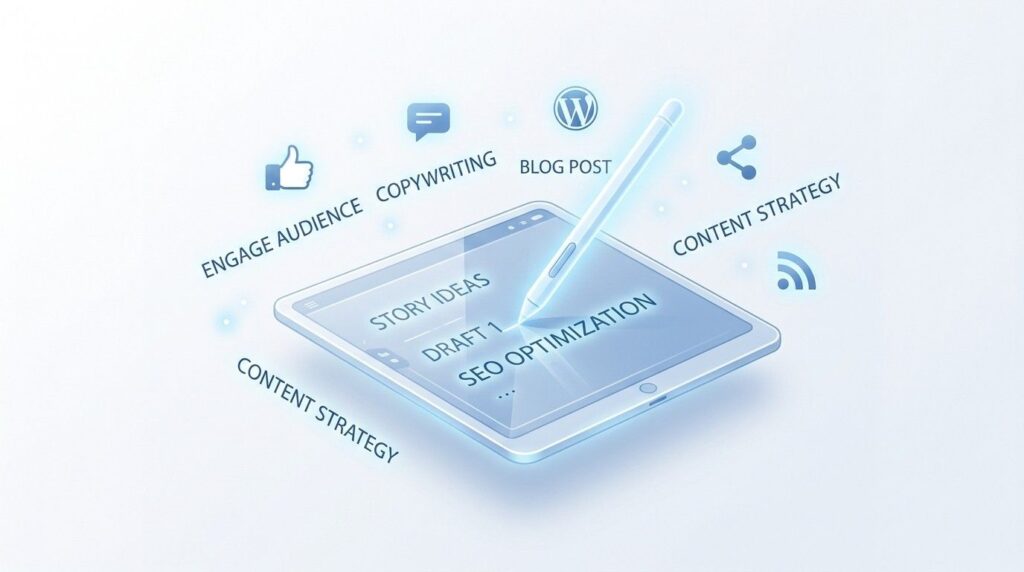
Writing tools are the most widely used AI category. They help you create blog posts, emails, ads, and social media content much faster than typing from scratch.
Top Tools
- ChatGPT: The best starting point for most people. Great for brainstorming, drafts, rewrites, and summaries. Free tier available.
- Claude AI: Strong at long-form writing and keeping a consistent brand voice. Handles complex documents well.
- Jasper AI: Built specifically for marketing teams. Includes templates for blogs, landing pages, and email campaigns.
- Copy.ai: Best for short-form copy like ads, product descriptions, and social posts. Fast and easy to use.
- Writesonic: Handles long articles well. Has a built-in SEO mode that connects directly to search data.
| Pro Tip: The 80/20 Rule |
| Let AI write 80% of the first draft. You handle the final 20%. This keeps your content accurate, human-sounding, and on-brand. Never publish AI content without reviewing it first. |
4. Best AI Tools for Automation and Workflow

Automation tools connect your apps and run repetitive tasks for you. Once set up, they work around the clock without any input from you.
Top Tools
- Zapier: The easiest option. Connects over 6,000 apps and requires zero coding skills. Perfect for small teams and solo users.
- Make (formerly Integromat): More powerful than Zapier for complex, multi-step workflows. Slightly steeper learning curve.
- Microsoft Power Automate: The best choice if your team already uses Microsoft 365 tools like Teams and Outlook.
Example workflow: A new lead fills out your website form. Zapier adds them to your CRM, sends a welcome email, and creates a task for your sales team. All automatic, zero manual steps.
5. Best AI Tools for Coding and Development
Coding AI tools write, review, and fix code for you. They also catch bugs before they reach your users.
Top Tools
- GitHub Copilot: Suggests code as you type inside your editor. One of the fastest ways to reduce development time.
- Cursor: An AI-first code editor. Ideal for solo developers and small engineering teams.
- Replit AI: Great for beginners. Helps you build and test apps without a complex local setup.
- Mabl and Testim: Automated testing tools. One engineering team cut their CI/CD pipeline time from 45 minutes to 12 minutes using these.
You do not need to be a developer to use tools like Replit. Many beginners build their first working app in under an hour.
6. Best AI Tools for Marketing and SEO
Marketing AI tools help you rank higher on Google, write better ads, and manage your content calendar without burning out your team.
Top Tools
- SurferSEO: Analyzes the top-ranking pages for your keyword and tells you exactly how to optimize your article.
- AnswerThePublic: Shows you what people search for online. Great for finding blog topics and FAQ ideas.
- HubSpot AI: Manages your CRM, email marketing, lead tracking, and reporting in one platform.
- Midjourney and Canva AI: Create professional-quality images and graphics in seconds. No design skills needed.
- Pictory.ai: Turns a blog post into a short video in about 15 minutes. Great for repurposing content.
| Tool | Best For | Free Tier? |
| SurferSEO | SEO content optimization | Trial available |
| AnswerThePublic | Keyword and topic research | Yes (limited) |
| Canva AI | Social media graphics and visuals | Yes |
| Pictory.ai | Blog to video conversion | Yes (limited) |
| HubSpot AI | CRM and email automation | Yes (free plan) |
7. Best AI Tools for Data and Analytics
Data AI tools turn raw numbers into clear charts and plain-English answers. You do not need a data science background to use them.
Top Tools
- Tableau AI: Builds visual dashboards from your data. You can ask questions in plain English and get instant charts.
- Power BI Copilot: Microsoft’s AI analytics tool. Ideal for teams already using Excel and the Microsoft ecosystem.
- ThoughtSpot Sage: Type a question in plain text and it queries your database automatically. No SQL required.
- Google AutoML: Lets non-technical teams build machine learning models. A retail team used it to cut inventory waste by 23% in 6 months.
8. Best AI Tools for Customer Support
Customer support AI handles routine questions automatically. This frees your support team to focus on complex issues that need human judgment.
Top Tools
- Intercom Fin: Resolves support tickets without human help. Handles up to 70% of incoming chat conversations on its own. Reviewing AI chatbot conversation archives can help businesses understand customer behavior patterns and improve automated support workflows over time.
- Freshdesk AI: Suggests replies to agents and tags tickets automatically. Cuts average response time noticeably.
- Zendesk AI: Works across email, live chat, and social media. Suited for larger support teams with high ticket volume.
9. How to Build Your AI Tool Stack

An AI stack is a small group of tools that work together to cover your most important tasks. You do not need to use every tool mentioned in this guide.
Starter Stack (Free to $47/month)
Professional Stack ($50 to $150/month)
- Writing and SEO: Jasper AI and SurferSEO
- CRM and email: HubSpot AI (starter plan)
- Automation: Zapier or Make (paid tier)
- Analytics: Power BI Copilot
Enterprise Stack ($200+/month)
- Coding: GitHub Copilot
- Data and ML: Google AutoML and Tableau AI
- Customer support: Zendesk AI
- Infrastructure monitoring: AIOps platform
Start with the starter stack. Only upgrade when a free tool becomes a limiting factor. This approach keeps your costs low while you learn which tools deliver the most value for your specific work.
10. Common Mistakes to Avoid
Most people run into the same problems when they first adopt AI tools. Knowing these mistakes upfront saves you time and money.
- Choosing tools based on hype rather than your actual needs. Always confirm a tool solves a real problem you have today.
- Using too many tools at once. More than 8 tools creates overlap and confusion. Start with 3 and grow slowly.
- Publishing AI content without reviewing it. AI tools make mistakes. Always fact-check and edit before publishing.
- Pasting sensitive customer or business data into public AI tools. Check the privacy policy before using any tool with confidential information.
- Skipping team onboarding. A tool your team does not know how to use is money wasted. Budget time for training.
Frequently Asked Questions
What does DTRGSTech mean when talking about AI tools?
DTRGSTech is a content and methodology tag used to group AI tool research and guides under one searchable topic cluster. It helps teams and writers organize how they evaluate and recommend AI platforms.
How many AI tools should I use at one time?
Most individuals do well with 3 to 5 tools. Teams can go up to 8 tools across different work categories. More than that tends to create tool overlap and makes it harder to build consistent habits.
Are free AI tools good enough for real work?
Yes, for many tasks. ChatGPT’s free tier, Canva AI, and Zapier’s free plan cover a wide range of daily work. Move to paid plans only when you hit the limits of what the free tier allows.
Can I use AI tools without any technical background?
Absolutely. Tools like ChatGPT, Canva AI, Zapier, and HubSpot AI are designed for non-technical users. You can get real, measurable results without writing a single line of code.
Which AI tool is best for writing SEO articles?
SurferSEO is the top choice for SEO optimization and on-page scoring. Pair it with Jasper AI or Writesonic for the actual writing. AnswerThePublic helps you find the exact questions your audience is searching for.
How do I verify that AI tool outputs are accurate?
Always fact-check any specific claims, statistics, or figures that AI generates. AI tools can sound confident while being wrong. Treat AI output as a strong first draft, not as a final source of truth.
What is the cheapest useful AI stack I can build?
You can build a solid working stack for under $50 a month. Use ChatGPT free for writing, Canva AI free for design, and Zapier free for automation. This combination covers most everyday content and productivity needs.
Which tools work best for a solopreneur or blogger?
A three-tool starter stack works well: ChatGPT for writing and ideation, SurferSEO for content optimization, and Canva AI for visuals. This combination covers roughly 80% of what a solo content creator needs to produce professional output.
Conclusion
Knowing which AI enabled tools to use in DTRGSTech is a skill that pays off every single week. Pick one tool per category. Test it for 7 days. If it saves you time, keep it. If it does not, try another.
The tools covered in this guide are used by real teams to write faster, automate workflows, rank higher on search, and serve customers better. Together, they form an AI stack that grows with your work.
Start small with the free starter stack today. You do not need a large budget to see real results. Three well-chosen tools used consistently will always outperform ten tools used poorly.
| Your 3-Step Action Plan |
| Find your biggest daily bottleneck: writing, repetitive tasks, or research.Pick one free AI tool from that category and use it every day for 7 days.Once it sticks, add one more tool from the next category in your workflow. |
